Welcome to the Wanderbox Builds blog series, a showcase of some of our semi-custom adventure vehicle customer builds in all their varied forms, from 24-foot just-the-essentials backroad bivies to 44-foot top-shelf land yachts. This series provides an in-depth, behind-the-scenes look at each build, from the customer’s requirements and how we achieved these to specific design and construction techniques employed at each stage of the rig’s build-out.
Our last blog introduced the new Wanderbox Builds blog series and detailed the Requirements Analysis and Design Process that we use to design the perfect Wanderbox for each customer, specifically an Outpost 29 4×4 we built in 2024 for our customers Jay and Kelly in Arizona. This installment goes into detail about the subframe and camper body design & construction of our adventure vehicles and again discusses the process we followed and the resulting construction of Jay and Kelly’s unique dream rig.
Read on for an in-depth overview of how we’ve designed the structural components of the living space or habitat of each Wanderbox, and how it mounts to the truck chassis’ frame rails via the subframe, to allow for the flex that rigs encounter in the off-road environments that Wanderbox rigs are designed to thrive in.
Quick note: this blog details the build of a Gen1 (first generation) Wanderbox, which started in 2023 and has a steel subframe with an aluminum main cabin and cabover frame. In a future blog, we’ll delve into our latest Gen2 design which uses aluminum for both the subframe and the habitat body frame.
Evolution of Motorhomes for Off-Road Use
Before we go into how we build a Wanderbox, it’s important to talk about why we build them like we do, and that requires some background on how motorhomes have evolved and how people use them.
People buy campers for different reasons—the majority to camp/hike/bike/fish/etc. for short weekend trips or vacations with their families, some to live in long-term as “full-timers.” Most stays are at campgrounds or established campsites, while some “boondock” for extended periods of time at “primitive” or “dry” campsites far away from the masses. Some will suffer cramped living quarters and minimal amenities for a few days, while others want most of the comforts of home wherever they go “glamping.”
This diversity of uses and applications has been going on for quite a long time—motorhomes have been around, believe it or not, since the late 1800s. The Wanderer (we’re not making this up) was a horse-drawn RV, made in the UK starting in 1884. Numerous other types of motor-driven RVs or motorhomes have come since, in many shapes and sizes.
Nowadays, a traditional motorhome is designed to take a couple or family down paved highways and byways to campgrounds or established campsites where a reservation is often required, and your neighbors are usually close. Most sites have hookups for electricity and water/waste where you can stay “camped” for days, weeks, or a season. They are the camping equivalent to high-density apartment or tract house living, where the campsite owner’s goal is to jam as many “campers” into the available space as possible, optimized for density instead of a communal experience with nature.
Off-road RVing has also been around for a while. Europeans were some of the first to take trucks designed for commercial or military applications put camper shells on them, and outfit them for extended trips across Europe and Africa. These became known as Expedition Vehicles and were often built on truck chassis like a Mercedes Unimog or a Stewart & Stevenson LMTV.
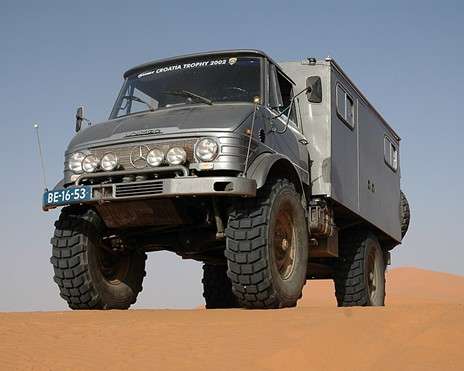
(credit: Wikipedia).
In 1998, Bill Swails started EarthRoamer and began creating expedition vehicles for the American market. Mike and Renee Van Pelt started Global Expedition Vehicles (GXV)—another top player in the early US expedition vehicle market—around 2005 (in 2022 Storyteller acquired GXV). The high price of these early manufacturers’ vehicles relegated them mainly to being toys of the wealthy—a new EarthRoamer starts around $700K and some models exceed $1 million.
Today, at least a dozen other US companies are building off-road motorhomes on a Class 5 truck (up to 19,500 lbs GVWR) like a Ford F-550 or RAM 5500, which mimic the appearance and function of an EarthRoamer. Storyteller’s Hilt and Next models are good examples of how this segment of the RV industry is moving down market in price and making expedition vehicles more available and accessible to the mass market. But with units typically costing $450,000 or more, price is still a barrier to many wanting to enjoy the off-road glamping dream.
Traditional motorhome manufacturers started producing slightly beefier models several years back that provide some 4×4 capabilities while keeping the more traditional Class C appearance—calling these Super-C’s. Thor with their Magnitude and Omni models, and Dynamax with their Isata™ 5 and 6 are examples of mass-market Super-C motorhomes. Costing in the mid 200’s to the 300’s, these units are less expensive than the EarthRoamer knockoffs but offer limited off-road/off-grid capability and are still mass-produced like a traditional motorhome, typically with lower-quality materials and lower-end systems like solar.
Since their beginning, motorhomes have provided a way for people to travel to remote destinations and reside for periods of time in some level of comfort. In the last twenty years or so, 4×4 adventure vehicles akin to Expedition Vehicles have steadily grown in popularity in the US and around the world. In the last five years or so, they have become affordable enough for more people.
Although the primary use of traditional motorhomes is still for weekend or vacation stays, COVID showed more workers and employers that working remotely was possible. With home prices through the roof and only getting worse, more people are considering motorhomes for lengthier stays or to live in permanently. Retirees continue to make up a large segment of campers who stay out for longer than a short vacation, often as “full-timers.” With campgrounds more crowded than ever and the supply of new properties seemingly never catching up with the growing demand, more versatile RVs and motorhomes that allow people to Go Out Farther and Stay Out Longer are increasing in popularity.
In 2021 we founded Wanderbox to re-envision how people could commune with nature in a motorized home on wheels that was designed for lengthier stays off-grid. This vision resulted in some core “requirements” that guide the product development for our expedition vehicles:
- A strong, safe, and very durable, climate-controlled living envelope
- Quality and craftsmanship built-in, from overall design to every detail
- Built on a truck chassis with adequate 4WD chops to travel down moderately rough roads
- A wide range of sizes, features, and options to fit different uses, lifestyles, and personal tastes
- Work-friendly layouts and high-speed connectivity to work remotely when needed
- Modular-by-design so many of the same components can be used across different models
- Serviceable-by-design so that components can be easily serviced and upgraded
- Usable-by-design so you don’t have to be a rocket scientist or RV tech to use one
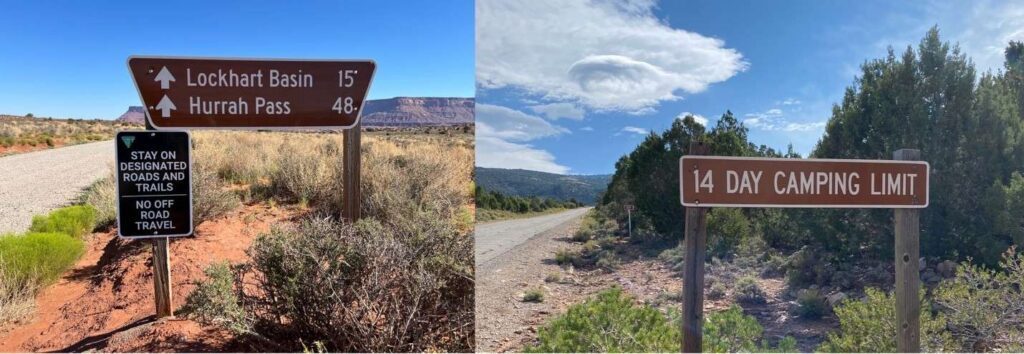
Out West where we’re based and across the US, there are millions of acres of public land managed by the states or the BLM (Bureau of Land Management) available for Americans to visit and often to camp on. On many of these public lands, the Fourteen Day Law applies—meaning you can camp for up to 14 days before having to move along.
Our goal at Wanderbox is to build expedition vehicles that can go off-roadand stay disconnected from the grid for days, weeks or months, in comfort, for a reasonable price. To do this, we had to re-invent how a motorhome is made to be suitable for this purpose. To Go Out Farther and Stay Out Longer.
Configurable By Design – Wanderbox’s Unique Modular Platform
The vision for the Wanderbox design and construction is unique in the industry. We liken our design strategy to a hardware or software platform where the many complexities of the architecture are built into the design and allow for many different variations in the end application—in our case, your purpose-built Wanderbox. This strategy works equally well in our smallest Wanderbox with 10-foot-long living spaces to our longest 30-foot beasts.
. Think of the Wanderbox systems that “just work” and provide services as apps on platforms like Apple iOS or Google Android but for off-grid expedition vehicles. Systems that keep your living space warm on a cold night or the internet and security system that keeps you connected and safe are just a few examples,. Our plug-and-play modular architecture allows for a large number of options in every functional area, with support for many features and options built into the design.
Easily, robustly and dependably managing the complexity our platform conceals is our secret sauce—how all the different systems function and interconnect—. How the press or swipe of a finger on one of our touchscreens interacts with the complex systems they control, from our expertly designed solar/lithium electrical systems to our highly efficient HVAC systems that help make our R15+ insulated living spaces like Yeti coolers on wheels, to internet connectivity and our entertainment systems that help connect us to the world (or not). It’s easy for a few different models like in traditional RV design, but much more complex when models span a wide range of lengths, shapes, different truck chassis and a myriad of different features and options.
Wanderbox has functionality that’s second to none, like lithium battery bank capacities from 5- to 60-kWh (that’s 2400 amp-hours!). Interoperability that’s baked in, to five different truck chassis manufacturers to five different toilet options. Craftsmanship and durability that’s designed to provide a first-class experience over a lifetime of use. Serviceability and upgradeability that’s planned and built in.
The goal of building semi-custom, purpose-designed and built Wanderbox expedition vehicles was not a sustainable vision without the modular platform we designed for it, so we did what no other camper manufacturer has done, and built the first and only such platform of its kind.
Our Torsion-Free Subframe – Designed for Moderately Off-Road Travel
They say a house is only as strong as its foundation, and it’s no different with a house on wheels. Before the camper shell and frame are constructed, a very important part of the Wanderbox—its Subframe, is built and mounted on top of the truck chassis to act as the foundation for the camper habitat that is built on top of it. The Subframe has a very important function: to isolate the natural movement of the truck’s chassis from the habitat above it so it doesn’t tear apart as it travels over various types of terrain.
Some Expedition Vehicles have complex pivot-based systems that allow the truck chassis and habitat to “articulate” or separate at certain points when going over rough terrain—terrain that off-road trucks like Unimog’s, LMTV’s and modified 4×4 light duty pickup chassis are built to traverse. These “no torsion” or “zero torsion” systems are designed for advanced off-roading, even “rock-crawling” down very rough roads where 4WD and even locking differentials and “airing down” tire pressure may be required to get up/down steep inclines or through very rocky sections of road. Many of the US companies making Expedition Vehicles incorporate this type of subframe into their design.
We design and build Wanderboxes for moderate off-road/off-pavement travel, like getting down maintained dirt roads that may have gotten rough between seasonal scrapings and have short rocky patches or washboard sections that a traditional motorhome would suffer significant damage getting down unless you drove at a snail’s pace and didn’t try often. Even though all Wanderboxes come with 4×4 and we offer options for large tires and high-clearance suspensions, they aren’t designed for intense off-roading and should not be used for such.
A pivot-based subframe design typically adds significant height and weight to an Expedition Vehicle, which is a reasonable trade-off if you want to drive down some seriously hairy Jeep roads and camp overnight. But the added height and weight mean the living spaces of these campers are typically small and cramped, which doesn’t work for what we design a Wanderbox for—capability AND comfort—so a pivot-based subframe system wasn’t a good fit. Instead, we opted for a lower-profile and lighter-weight spring-based system we designed in-house with our experienced engineers and fabricators.
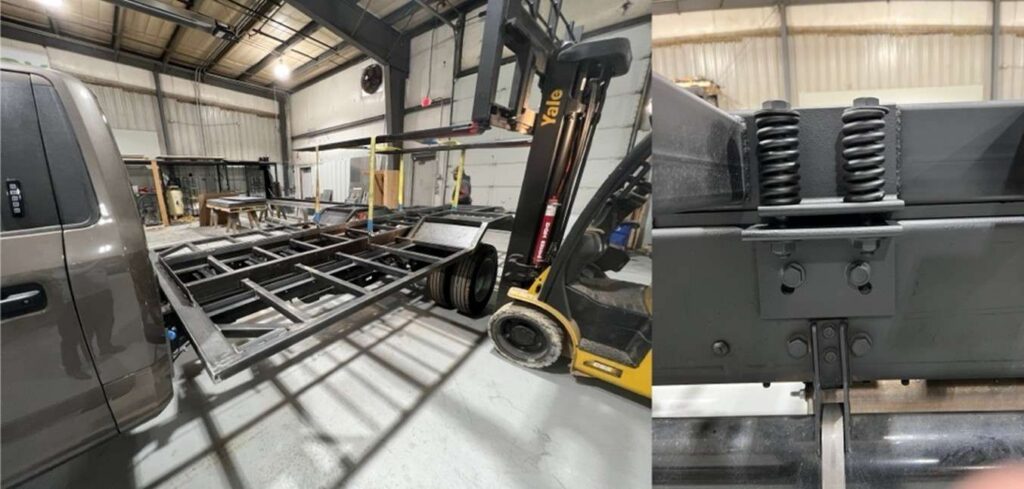
Significant on-going R&D and testing goes into the design of the Wanderbox subframe. Our spring-based “torsion-free” design effectively isolates the truck chassis’ flex as it traverses moderately rough terrain from the living space of the habitat. This design works very well for traveling down reasonably rough dirt roads and has been used for years in applications like water trucks where heavy loads far greater than a Wanderbox habitat must be transported safely and securely. The number of sets of springs that connect the subframe to the truck chassis’ frame rails and the “spring rate” (springiness) of the springs are matched to the specific length Wanderbox we’re making, so that each will articulate appropriate to its design goals.
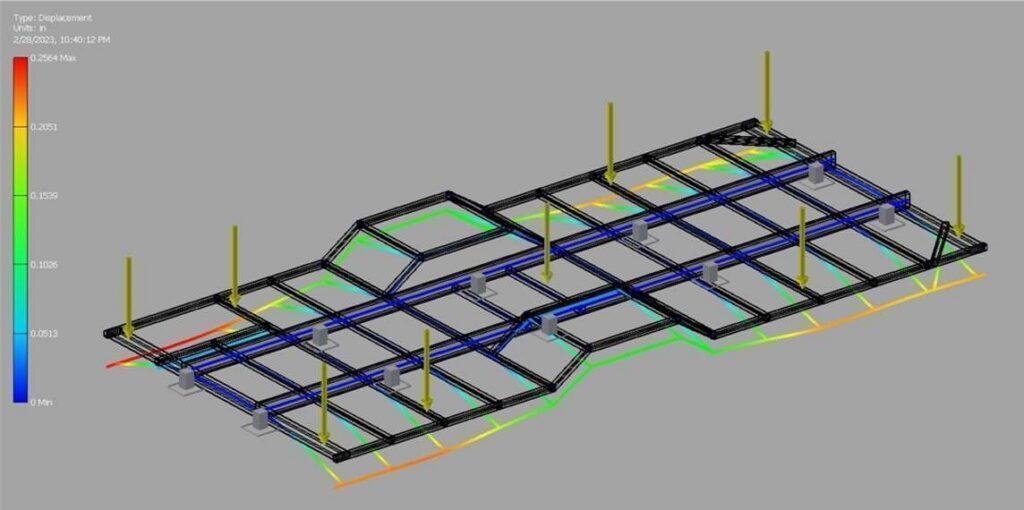
We put our subframe designs through their paces by running both software-simulated and real-world destructive tests. The image above is from some of the FEA tests we conducted for our Gen1 subframe design where loads indicated by the dark green arrows simulate the forces exerted by the habitat and movement of the unit on the subframe. The red areas show the weakest points and help determine where structural design improvements might be made to improve the structural integrity of the subframe assembly.
A quick reminder of what a Wanderbox is—and is not—designed for. We’ve had all kinds of adventure vehicles that have taken us camping to all kinds of cool places, but we grew tired of sacrificing comfort for getting off the beaten path—frankly, life’s just too short and we like comfort, not suffering, with our nature fix too much! Sleeper berths that feel like coffins and bathrooms that you can’t stand up or turn around in might be OK for a day or two, but it’s not what Wanderbox is about.
We make Wanderbox vehicles to blend comfort with capability, to be your Mothership for adventure and not easily get stuck in mud when it rains on the Bentonite clay road to Gooseberry Mesa’s world-class mountain biking near Zion, or in snow on the I-70 passes on your way to Fruita or Moab from Denver. Tow a Bronco or Wrangler as your Lunar Rover if you want to rock-crawl, then head back to the comfort of your Wanderbox for a nice shower, an amazing meal, a comfy bed, and room for friends if it starts to pour down rain where you’re camped just down from your favorite trailhead.
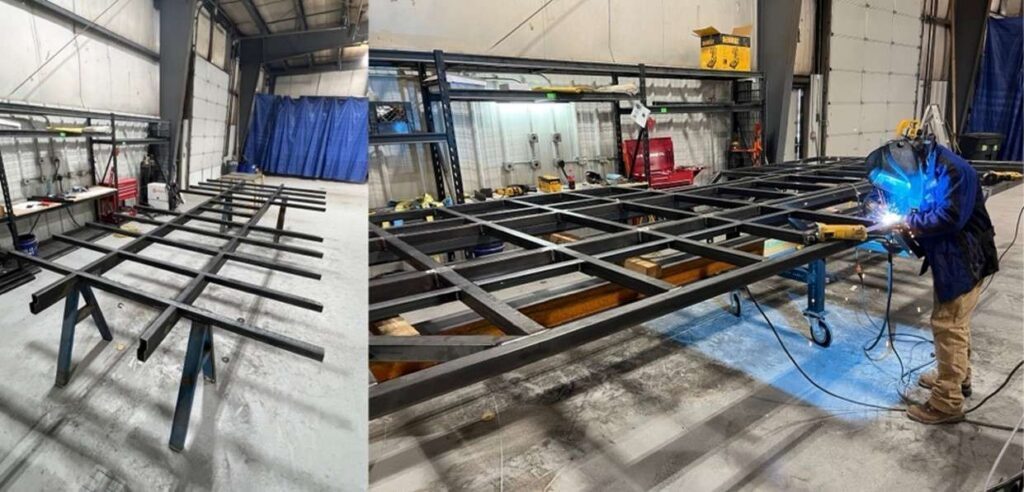
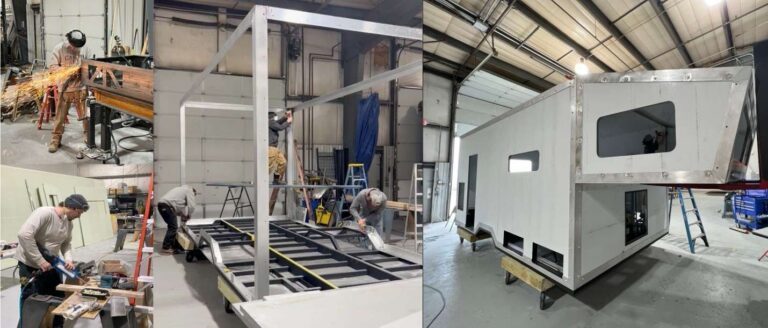
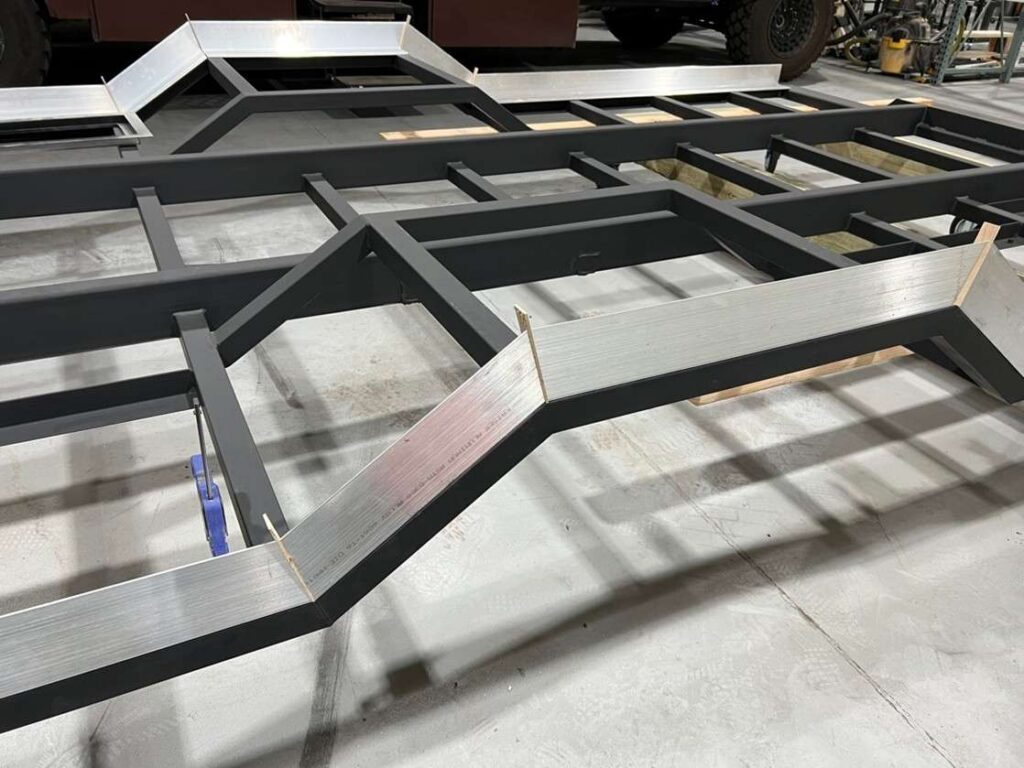
In our Gen1 subframe design that we used for Jay and Kelly’s Wanderbox, after the steel frame is cut, laid out, and welded, a thin sheet of aluminum is glued on the underside using glue that is specially designed to prohibit galvanic corrosion which occurs when steel and aluminum come in contact with each other. This aluminum sheeting creates a barrier on the bottom of the subframe that keeps insects, rodents, and the elements from entering the underside of the “basement” where many of the systems are installed, like water/waste tanks, HVAC, plumbing, and electrical system components.
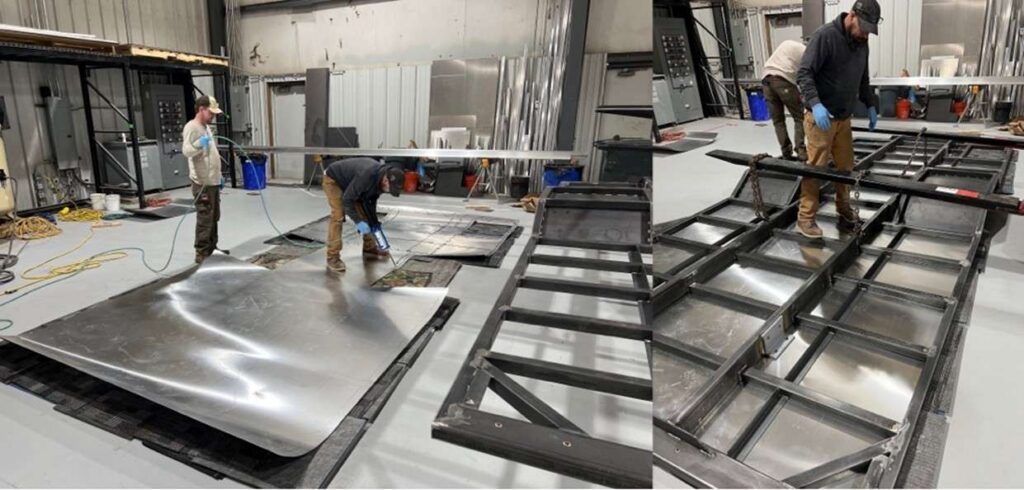
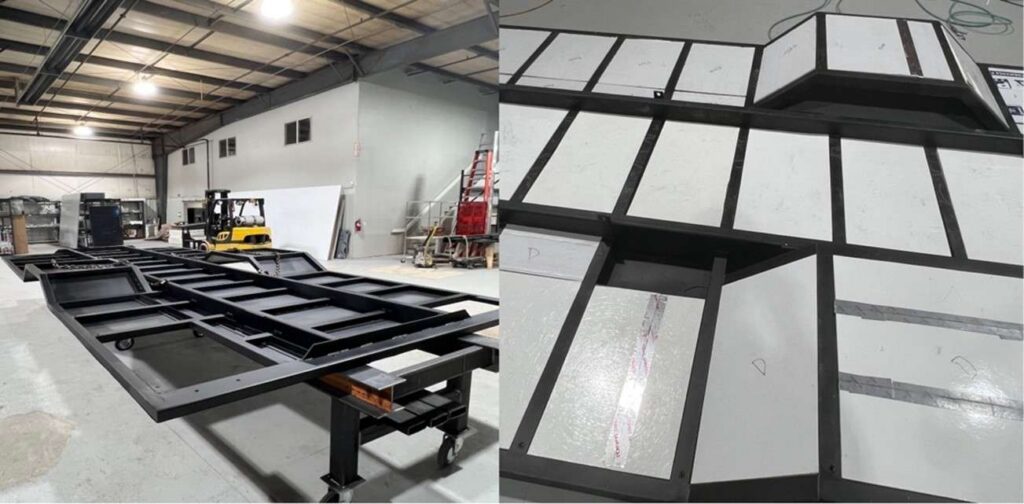
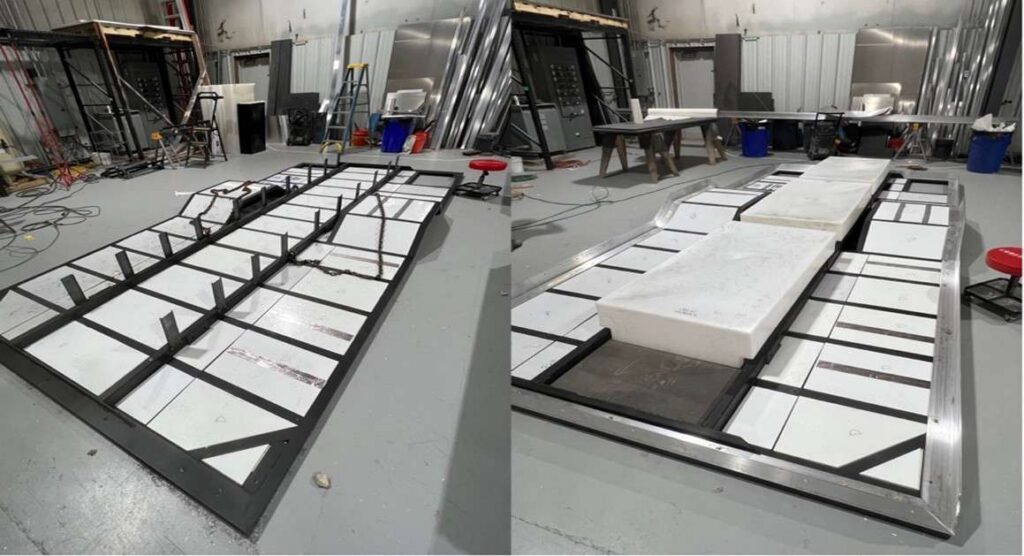
After the sheeting is installed, the subframe is primed and painted, and 2” of R13 polyisocyanurate closed-cell insulation is installed in the cavities of the subframe’s long sills (the long members that run front to back parallel/above the frame rails of the truck chassis and have the attachment points for mounting the subframe to the truck chassis) and the cross members. We then install the 4” x 4” x ¼” 6061 T6 aluminum angle that holds the walls to the subframe. Then Coosa, basically inorganic fiberglass plywood that’s used widely in the marine world, is fitted above the steel and insulation layer and glued firmly in place to make the floor of “the basement.”
Post & Beam Habitat Frame Construction: Lightweight but Very Strong
With the subframe completed, the corner and roof aluminum frame members of the habitat are installed, which create a “post & beam” type building frame for the exterior walls and roof composite sandwich panels to be glued into and fastened with special nylon bolts for added strength. Like the floor to wall angle sections, these aluminum sections are structurally welded and then grounded down until each joint is smooth.
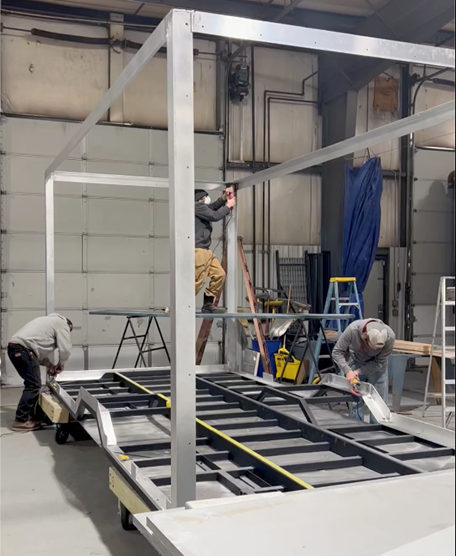
of this Gen1 Wanderbox.
The finished frame is lightweight but very strong, and our design works for any length Wanderbox and lets us place windows, doors and hatches pretty much anywhere the customer wants these. This habitat design is a differentiator since it allows us flexibility that other manufacturer’s designs don’t.
From an engineering standpoint, both the subframe and the habitat frame are designed to act as “torsion boxes” like a hollow core door or an airplane’s wing. The combination of the three-dimensional frame and the additional bracing that the “skins” of the exterior panels add makes each structure very strong. When the habitat and the subframe are joined together, they have the effect of creating layered torsion boxes, which further increases the structural strength of the whole assembly.
Shell Design 101: 3 Types of Camper Shells; Avoiding Thermal Bridging
There are basically three kinds of camper shells that manufacturers use to make their adventure campers:
- Laminated panel shell
- Molded fiberglass or carbon fiber shell
- Composite sandwich panel shell
Laminated Panel Shell
Laminated panels are what the traditional RV industry has been using for years for their wall panels. With this method, the exterior panel consists of an inside and outside layer of fiberglass—sometimes the exterior layer is aluminum sheeting—with wood or aluminum for structure and typically EPS closed cell insulation for insulation. These panels are made at the RV maker’s factory with expensive production lines and slapped together quickly. They aren’t very well insulated but are inexpensive to mass manufacture with CNC routers that make the window, door and hatch cuts quickly and precisely based on CAD designs.
Low cost and speed of manufacture are the top benefits of this approach to the panel manufacturer. Poor insulating capability (low R-value) and a tendency to delaminate are the downsides of this approach. Aluminum is a fantastic thermal conductor, so for units from manufacturers who make their panels where the aluminum tubing represents 80-90% of the thickness of their panels, “thermal bridging” is a common issue.
Thermal bridging happens when the wall material allows heat and cold to “wick” through the wall, which makes heating and cooling the unit harder and allows for condensation to form on the inside of the wall panel. Using wood for structural framing, as many do, helps limit thermal bridging but means rot will occur when any moisture gets into the wall panel.
Molded Fiberglass or Carbon Fiber Shell
Molded fiberglass or carbon fiber camper shell construction is a popular approach with expedition vehicle manufacturers. Some call this “monocoque” meaning one-piece, but these really aren’t one piece, because there is no way to pull a large completed three-sided camper shell out of a mold. Instead, they start out as multiple pieces pulled from different molds and get patched together with fiberglass or carbon fiber to make the completed shell.
Making a complete shell using the molded shell approach has significant up-front costs, and for this reason, manufacturers who utilize this method don’t/can’t allow for any changes in the design of the shell, like the layout of doors and windows. First “models” of each molded section must be made, which are basically the form that the final molded piece must look like, which takes considerable time to make and is often made with MDF.
Then a mold must be made for each of these sections. Once the molds are complete, they are used to form the matte and resin of the particular shell material—for instance, carbon fiber or fiberglass, with “mold release” sprayed into the mold before “lay up” so that the pieces can be pulled out of each mold when the pieces are cured.
As you might imagine, “Can I have a larger kitchen window?” or “Can I have a large skylight at the rear of the front cabover so I can take pictures of bears in Yellowstone?” aren’t things that can be done with such a molded shell design. Flexibility is non-existent, but many of the same shells can be made from the molds once they are made. The high up-front costs of this process are amortized over the life of the mold, which can produce lots of shells over many years.
Thermal bridging isn’t usually much of an issue with molded shell units, except when aluminum tubing is used within the wall design for structural support. Just like with laminated wall designs that use aluminum to give their walls structure, units from manufacturers who use the molded shell method and put large aluminum tube structures inside their shells for support can have major issues with thermal bridging.
Composite Sandwich Panel Shell
Manufacturers like Wanderbox, who use a composite sandwich panel shell design for their camper bodies, use a layered “sandwich” of different inorganic materials with each layer chosen for key properties like durability, paint and glue adhesion, screw-retention and R-value.
Each manufacturer we know of that uses the composite sandwich panel shell design uses their own proprietary single, thick panel design including the extrusions that hold the panels together to form the completed shell. Most use FRP (fiberglass reinforced plastic) or fiberglass sheet skins with PUR, PIR or their own proprietary insulation glued inside the skins to form a single large, thick (2-2.5”) panel that forms both the exterior and interior walls. These thick, single walls usually have an R-value of ~R10.
The aluminum extrusions most used to connect panels have aluminum or PVC extrusions that have some means of creating the thermal break needed to avoid thermal bridging. The two most common techniques for building thermal breaks into extrusions are the polyamide (PA) and pour & debridge methods.
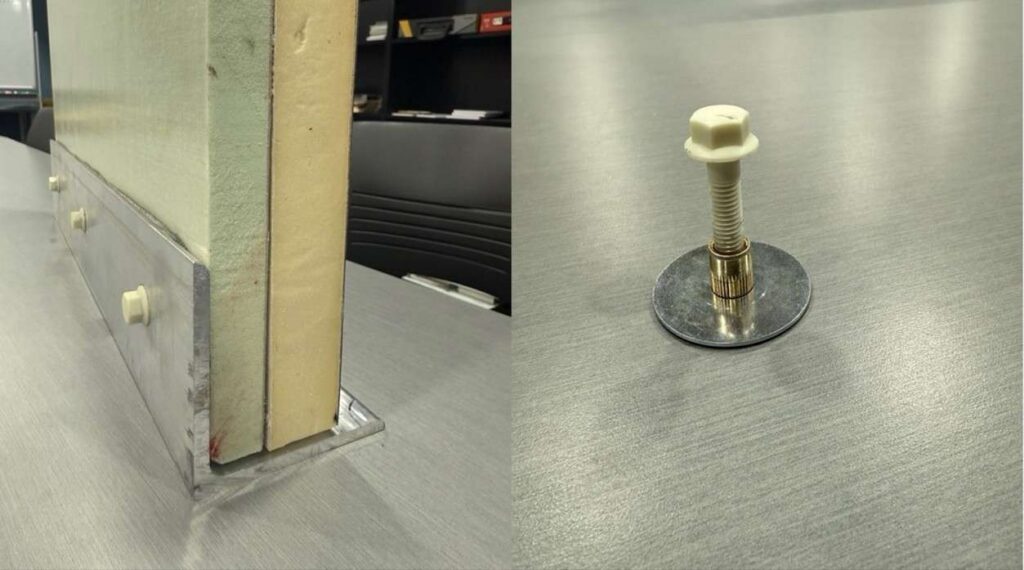
Compared to other manufacturers who use the composite sandwich panel method for wall construction, Wanderbox uses a different layering approach, with a separate thinner 1” exterior shell layer and another layer inside for insulation. Our combined wall thickness is ~2.5 inches and the R-value of our side walls is ~R16, with our ceiling and floor panels having higher R-values.
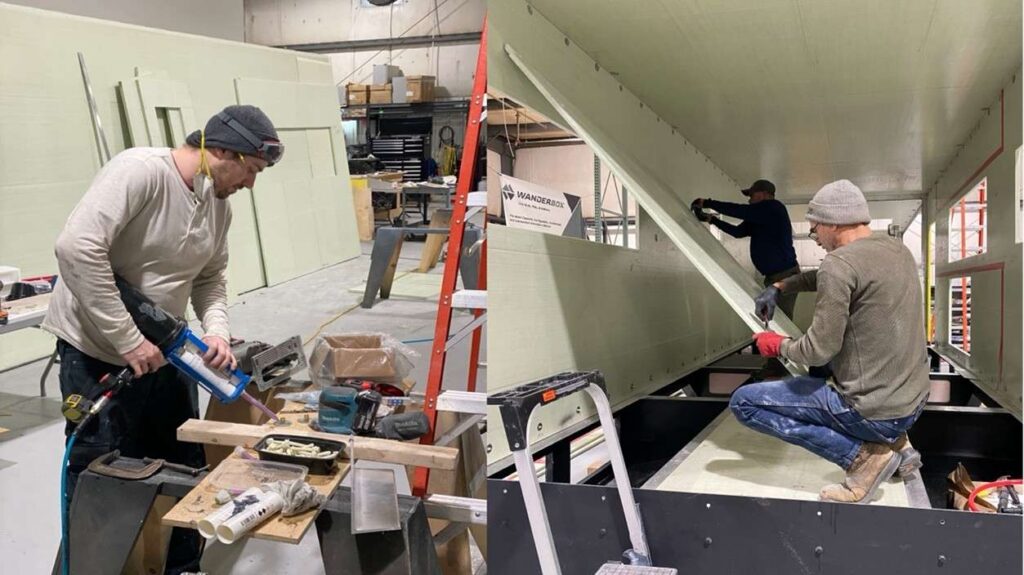
Our custom-engineered 1” exterior rigid panels (green material in the picture above) are made up of four 0/90/90/0-degree aligned layers of e-glass, thermally fused to a 0.95” PET foam core, and then another 4-ply e-glass skin. These panels are very light but extremely durable, and we can easily repair any dents that might result from accidents. They also hold screws nicely, plus adhere well to both the bed liner we use on our exteriors and the spray-on adhesive we use to bond the insulation to the interior of the outer layer.
Our internal insulation layer is made up of ~1.5” polyisocyanurate or PIR insulation, the highest R-value closed cell insulation available commercially. We use the two layers versus a single thicker panel to achieve the higher R16 side wall R-value versus the R10 of the single thick wall approach, plus to give us added flexibility to run wire chases, etc., just where they are needed.
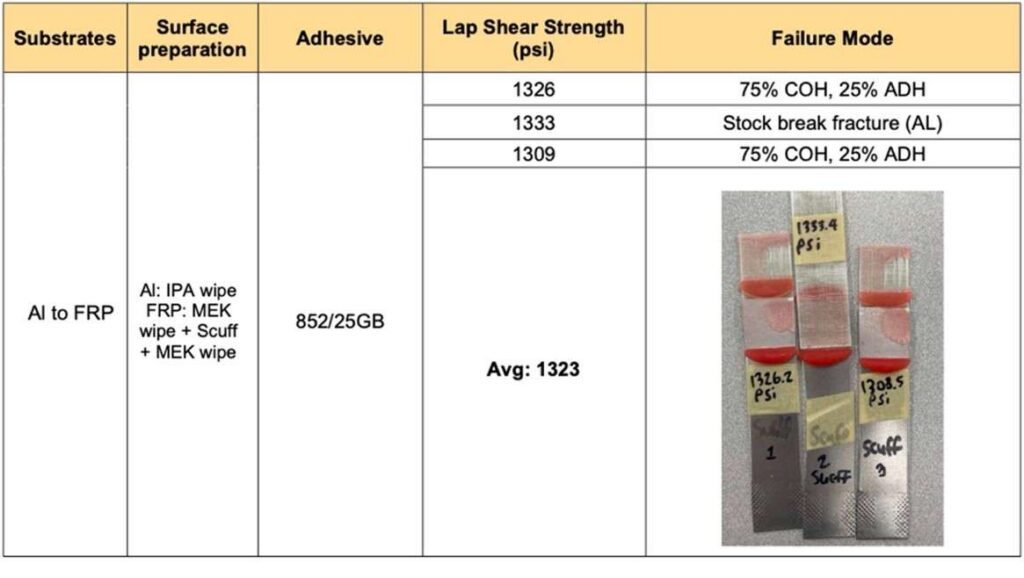
The exterior rigid wall and roof panels are cut to the exact length and width needed and are glued to the aluminum post and beam frame using advanced adhesives that we have researched and tested rigorously. The table below shows the results of the Lap Shear Strength testing that we did where the strength of the bond of aluminum to composite panel averaged over 1300 PSI, which is very high.
The bolts that we use to fasten the walls and roof in place and provide another level of structural strength beyond what our adhesives do are special glass-filled nylon bolts that are close to the strength of steel bolts. Because they have very low thermal conductivity, they are a simple yet very effective way to fasten our composite sandwich panels to our post & beam aluminum frame for the habitat with virtually no thermal bridging, requiring no special aluminum extrusions.
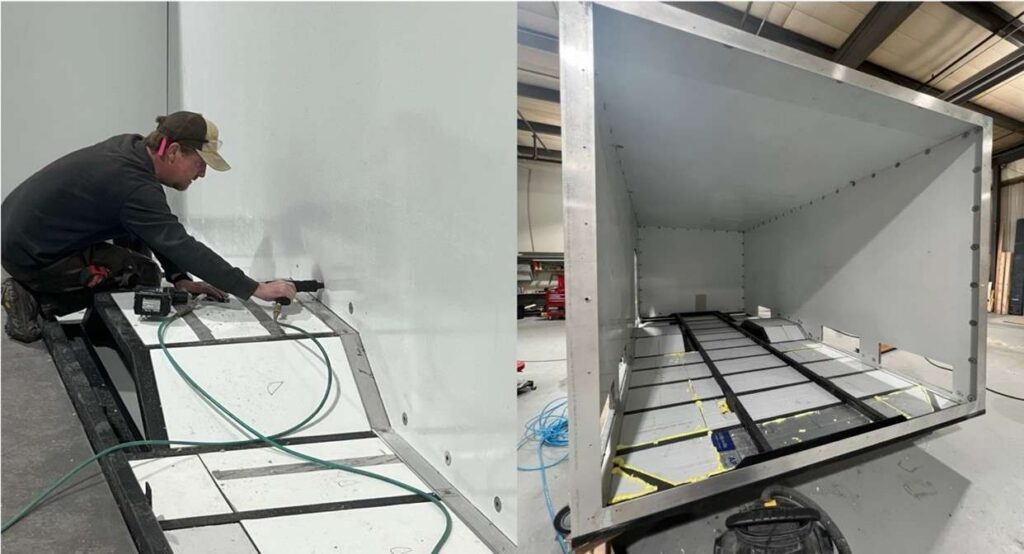
Once the panels for the roof and all walls are secured and the glue has cured properly, our team begins cutting rough openings for placement of the windows, door, and hatches for the customer’s unit. In this case, it was a rear door unit with two windows in the front and one on each side of the cabover, and several others throughout the main cabin.
Hatches just below the floor line on the Gen1 units provide access to all systems that will be installed under the floor for easy access and servicing once the unit is complete. The rough opening for the pass-through between the cab and the main cabin is also cut in before the shell of this 29-foot rig is complete.
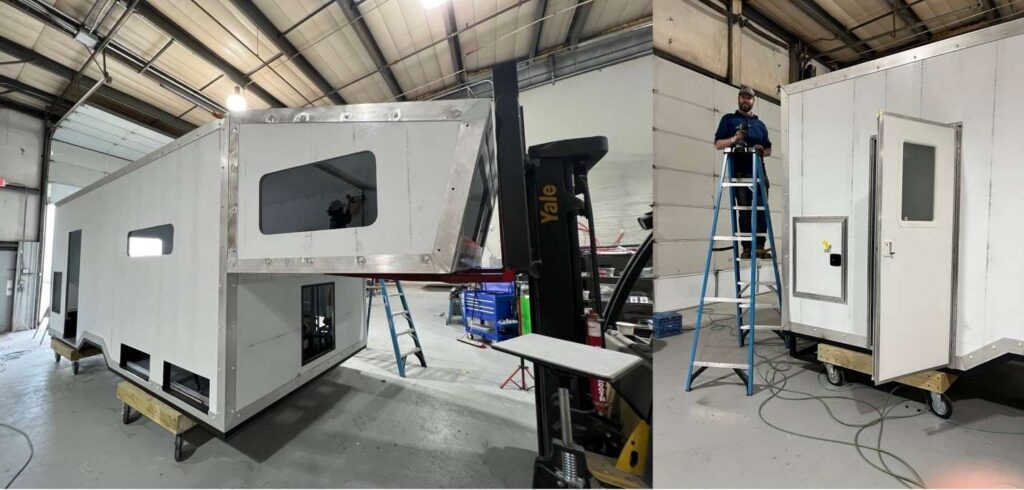
When the shell is completed, the next step is to begin installing all the systems the unit will have, like HVAC, plumbing, and electrical. The major components of these systems are installed under the floor in the climate-controlled area we call the Basement. The Basement and various components, HVAC hoses/lines, water and waste plumbing fixtures and lines, and electrical wires are the subject of Part 3 of this blog series.
The goal of building semi-custom, purpose-designed and constructed Wanderbox vehicles that meet each customer’s specific needs would not be achievable without the modular expedition vehicle platform we’ve painstakingly designed and implemented at Wanderbox, that all begins with our Subframe and Camper Body designs. Lithium battery options from 5- to 60+ kWh, freshwater options from 40- to over 200-gallons, five different toilet options, and most any interior design you can imagine, would not be possible without our innovative approach to designing and building each Wanderbox.
To achieve this vision, we had to reinvent how RVs are manufactured to achieve the high level of quality and configurability in each build and do so in a way that is scalable and sustainable. No other 4×4 motorhome manufacturer has a modular, flexible, and scalable platform for manufacturing units from 24-feet to 44-feet in length, with the almost infinite permutation of features and options that Wanderbox offers.
Up Next
In our next blog in the Wanderbox Builds series, we’ll discuss:
- Systems & Components: How Wanderbox designs in modular configurability to enable a wide range of living requirements and lifestyle needs
If you haven’t already, sign up for our newsletter if you want to know when the next one hits. Enjoy!